Whispers of the Underrated: Five New Heroes Emerge from the Shadows of Marvel Rivals
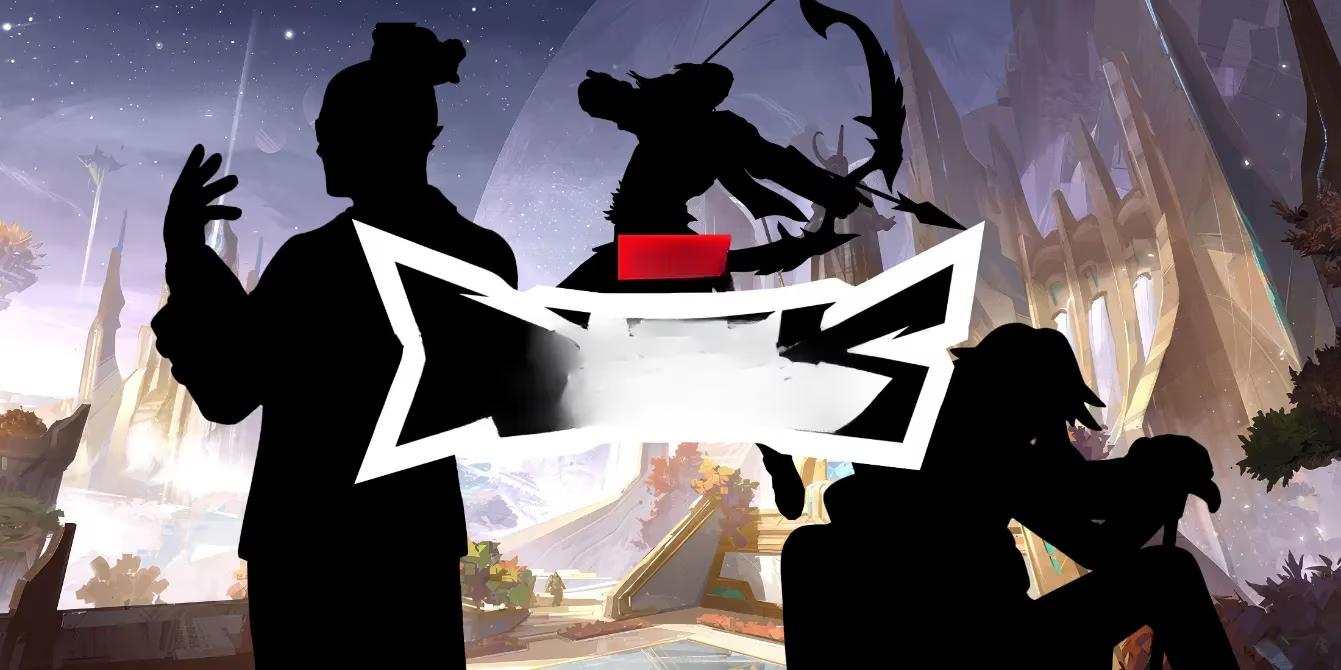
Marvel Rivals leaked silhouettes hint at five forgotten Netflix heroes with abilities subverting hero-shooter norms.
The morning mist still clung to the Tokyo 2099 skyline as I dropped into another match, the familiar hum of hero selection whispering in my ears. I remember the day the silhouettes first leaked—a pixelated prophecy scrawled across the digital void in early spring of 2025. Back then, the Marvel Rivals community was still basking in the glow of the Fantastic Four’s debut, and no one expected the next wave to arrive with such defiant obscurity. Yet here they are, woven into the very fabric of our daily skirmishes, five souls plucked from the footnotes of Marvel’s television legacy: Erik Gelden, Ray Nadeem, Tilda Johnson, Vanessa Fisk, and Ward Meachum. Some called them underwhelming; I call them poetry in motion.
I’ve spent countless hours since their release tracing the contours of their kits, learning to dance with their eccentricities. Vanessa Fisk remains my favorite enigma—her Ultimate ability is not a flashy explosion or a healing wave, but a deliberate withdrawal. She summons a helicopter, its rotors beating a farewell against the digital sky, and vanishes from the match. In a genre obsessed with eliminations, she weaponizes absence. I’ve seen entire lobbies freeze, their momentum shattered, as her silhouette fades into the clouds. It’s a reminded that true power sometimes lies in leaving the stage at the perfect moment. The first time I pulled it off, I could almost taste the sea salt from Hell’s Kitchen on my tongue.
Erik Gelden, by contrast, is all about sensory overload. When an enemy creeps near, my screen trembles and a high-pitched screech saws through my headphones—a headache manifest as game mechanic. I’ve come to appreciate this discordant symphony; it has honed my spatial awareness to a razor’s edge. His very presence turns every corner into a tense confessional, a litmus test for empathy. There’s a strange intimacy in sharing his pain, a bond forged between player and character that transcends the usual power fantasy. I often wonder if the developers intended him as a quiet protest against the sanitized radars of other hero shooters.
Then there’s Ward Meachum, the corporate viper, whose Ultimate is simply “having money.” No damage, no shield—just a brief economic miracle that tilts the match’s resource economy. I’ve watched allies roll their eyes as I pick him, only to gasp when a tide of upgrade points floods our side. He embodies the cold calculus of capital, a thematic masterstroke that forces us to question what true strength means on the battlefield. The visual effect is a cascade of golden tokens and stock ticker tapes, a glimmering avalanche that feels both obscene and exhilarating.
Ray Nadeem and Tilda Johnson bring a different shade of obscure brilliance. Nadeem, the FBI agent carrying the weight of his Daredevil Season 3 arc, plays like a man walking through a shattered mirror. His kit is built around investigation—revealing enemy locations, leaving phantoms of guilt, his voice lines crackling with self-doubt. I recall a match on the Hell’s Kitchen rooftops where his trajectory perfectly mirrored the narrative of redemption I’d cherished on screen. Tilda Johnson, the Nightshade from Luke Cage, weaves a tapestry of biochemical terror: slowing zones, pheromone puffs that invert controls, all delivered with a street poet’s cadence. She’s become my go-to for area denial, her laughter echoing through the lab-themed maps.
NetEase understood the assignment. The monetization around these characters is a love letter to fans who waited years for recognition. Nadeem’s skins—the immaculate suit he wore while trying to hold his life together, the dress shirt stained with moral compromise—are among the best-selling cosmetic items in the game’s history. I admit purchasing the “Burden of Proof” bundle the very night it dropped, driven by an irrational need to see my favorite flawed agent shimmer in midnight blue fabric. The community’s creative fire reignited too; fan art of Tilda’s punk laboratory and Erik’s migraine auras floods my social feeds daily.
What strikes me most, however, is how these five characters reshaped the very soul of Marvel Rivals. We entered Season 2 expecting X-Men powerhouses or cosmic entities, yet received a handful of broken, street-level dreamers. It was a gamble that could have fractured the player base, but instead nurtured a deeper appreciation for niche storytelling. I’ve participated in Ward Meachum-only tournaments where laughter at his “money” ult never fades. I’ve witnessed Ray Nadeem duos holding silent vigil at the edge of capture points. There is a tenderness here, a collective recognition that heroism wears a thousand human masks.
As I queue for another round in this eternal 2026 spring, I whisper a thank you to the leakers who first dragged these silhouettes into the light. They gave us not just characters, but conversations—about class, about suffering, about the quiet battles fought outside spandex and super-soldier serum. Marvel Rivals taught me that the roster doesn’t need to be a Hall of Fame; sometimes it needs to be a rescue mission for forgotten souls. And in every helicopter departure, every coin shower, every tremoring headache, I find a fresh reason to stay.
Comments