Marvel Rivals' Hero-Villain Pairing Strategy Shapes Future Seasons
Marvel Rivals' Hellfire Gala season introduces Emma Frost and playable villain Ultron, establishing a new hero-villain release template.
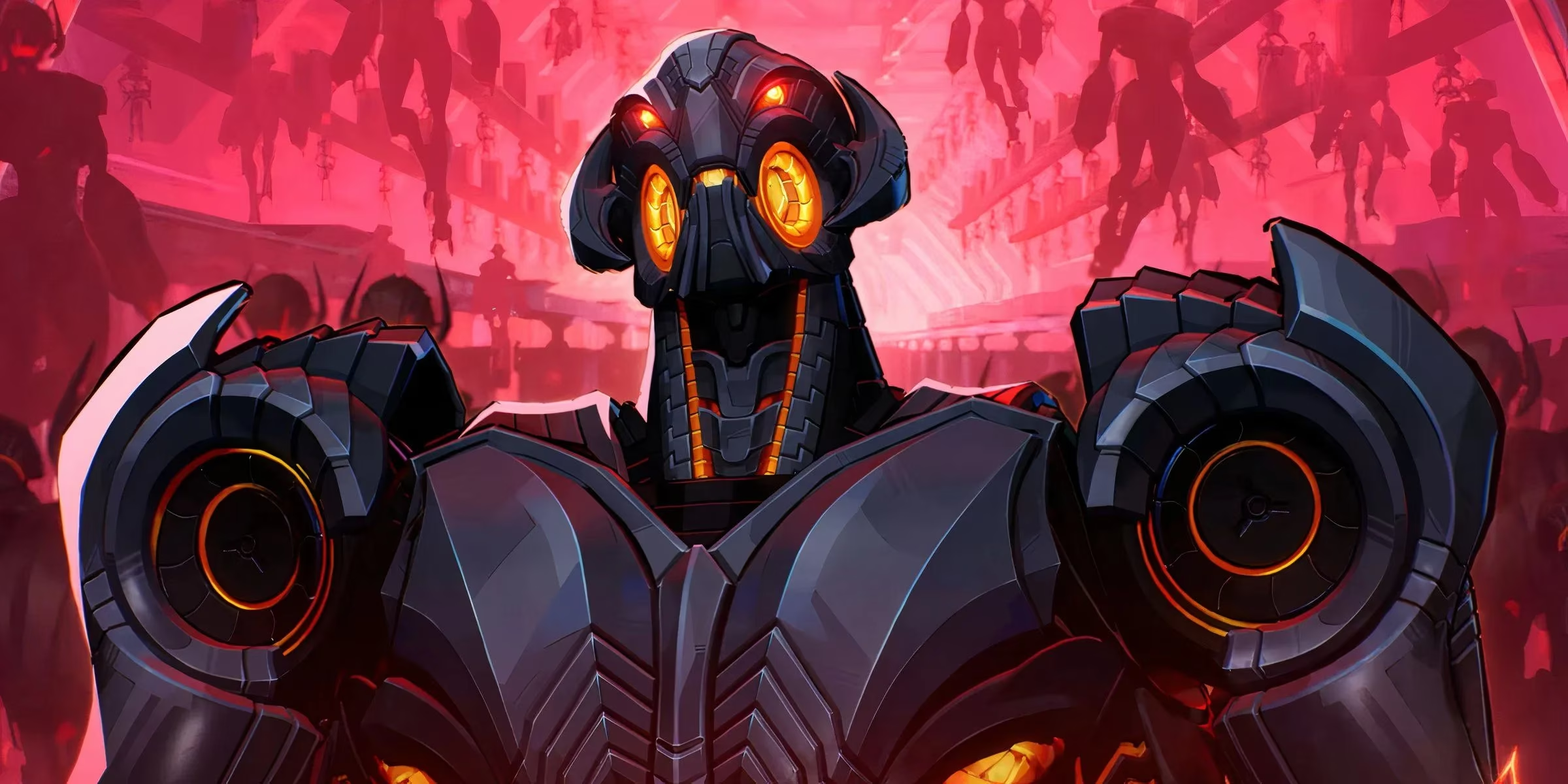
The arrival of Marvel Rivals Season 2, the Hellfire Gala, has sent ripples through the competitive community. Festive skins and sweeping balance adjustments are only part of the story. With Ultron’s leaked kit generating endless speculation, the exact influence he will wield in the Season 2.5 meta remains a mystery. At the same time, all eyes are on Emma Frost, a Vanguard whose unique telepathic abilities promise to reshape front-line engagements. What makes this season particularly noteworthy, however, is not just the characters themselves but the subtle design philosophy their pairing represents.
No two seasons in Marvel Rivals have been alike. NetEase has spent the game’s early life finding its footing, reacting to player demand, and experimenting with content cadence. Now, the developer has made a decisive pivot that will define the future of the roster. Starting with Season 3, the concept of releasing two characters over a three-month period is being abandoned. Instead, a new hero or villain will launch each month. This accelerated rhythm means the meta will evolve at a breakneck pace, and it opens the door for an even more deliberate pattern in character selection.
A Tale of Two Ambitions
The Hellfire Gala season stands out for a simple but powerful reason: it pairs one hero with one villain. Emma Frost, categorized as a ‘hero’ within the game’s unique continuity (though her comic-book history is far more complicated), and Ultron, the genocidal android, represent an intentional duality. This is the first time a season’s antagonist is a fully playable character from day one. In Season 0, Doctor Doom loomed over the narrative but never became selectable. Season 1 featured Dracula as a central menace, yet only Blade—his legendary foil—joined the roster. Ultron’s launch as a playable villain right beside Emma Frost marks a turning point.
Witnessing interactions between heroes and villains who rarely cross paths in other media is a genuine thrill. The banter, the rivalry lines, and the context of a victory screen take on new weight when a hero and villain share a release window. The synergy between Emma Frost and Ultron may not be an obvious pairing, but their simultaneous debut creates a dynamic template that NetEase could replicate to great effect in future months.
The Hero-Villain Balance Sheet
Since its launch, the disparity between hero and villain characters in Marvel Rivals has been both acknowledged and glaring. The roster is not devoid of antagonists—Loki, Hela, Venom, and Magneto all bring chaos to the battlefield—but they are heavily outnumbered by heroes. Every season that adds only heroes widens that gap. A deliberate, one-hero-one-villain release strategy offers a natural counterbalance.
Following the Hellfire Gala model, no future season would need to chain itself to iconic nemesis pairs. It would be easy to imagine a season where Daredevil arrives alongside Bullseye. The brutality of their encounters in Netflix’s and Disney’s Daredevil series has cemented their rivalry in the public consciousness. Translating that tension into game-ending cutscenes, lore entries, and mid-match voice lines would be sensational. Yet such a formula, while attractive, has built-in limitations.
The Limits of Nostalgic Pairing
Marvel Rivals is home to deep-cut favorites and household-name teams. The Fantastic Four are already fully playable, for example. When Doctor Doom finally becomes a playable character—an event many players consider inevitable—his launch cannot be accompanied by a climactic simultaneous debut of his most famous enemies. That moment has passed. He will arrive alone, or alongside a different hero, whose story is already written into the game’s evolving narrative.
The same constraint applies to Spider-Man’s gallery of rogues. Electro, Kraven, or the Lizard cannot debut side-by-side with the wall-crawler because he swung into the roster months ago. Still, a fiend like Kraven arriving next to a completely unrelated Marvel hero can be just as thrilling. It underscores how prolific and significant the villainous half of the Marvel universe truly is. The excitement of seeing a new villain challenge a hero they would never normally fight is an untapped well that NetEase can exploit.
A Roster Without Shrinking Horizons
Not every hero is blessed with a laundry list of arch-nemeses to thwart on a daily basis, but the Marvel pantheon overflows with heavy-hitters ready to cause mayhem. The Mandarin, Taskmaster, Carnage, Mister Sinister, and countless others stand waiting in the wings. Marvel Rivals obviously does not seem concerned about its pool of potential characters dwindling. With the shift to a monthly release model, the developer likely has a confident, long-term roadmap stocked with both heroes and villains.
The speed of new introductions will be staggering. A new character every month means twelve additions per year, a torrent of new abilities, team-ups, and counters that will constantly reforge the meta. Players who enjoy mastering a single hero will face constant adaptation, while those who love variety will never run out of fresh tools.
Shaping the Narrative
What makes the hero-villain pairings so compelling is not just the mechanical balance they bring to the roster but the narrative texture they weave. A season story can pit the newly introduced hero against the newly introduced villain in a way that feels urgent and personal. The Hellfire Gala gifted players a decadent, high-society backdrop in which Emma Frost and Ultron could play out their schemes and counter-schemes. Future seasons can draw on similar contrasts—a cosmic hero versus a street-level villain, or a mutant liberator against an anti-mutant zealot.
The decision to accelerate the release schedule and implicitly embrace a more balanced hero-to-villain ratio suggests NetEase has absorbed the community’s most persistent request: make the game feel like a true clash between good and evil, not just a celebration of the heroes. Villains bring personality, danger, and unpredictability. They offer players the chance to embrace morally complex fantasies, to wield power without the restraint of a conscience.
Looking Ahead
The road from Season 3 onward will be paved with new faces every month. Some will be heroes, some villains, and some the morally grey anti-heroes who blur the line between. The Hellfire Gala’s accidental blueprint—a hero and a villain sharing the spotlight—may not become a rigid rule, but its elegance is undeniable. It ensures that each season leaves the game feeling richer in conflict, more authentic to the source material, and more exciting for the community that keeps the battles raging.
With Emma Frost’s diamond-hard defenses and Ultron’s cold, calculated aggression now live in the game, the next chapter is already being written. The question is no longer whether Marvel Rivals can sustain its momentum, but which iconic pair of adversaries will step through the portal next month, ready to tear each other apart—and who will be standing when the dust settles.
Comments